

Journal
Office Lease Questions for Growing Businesses | CorporatEdge
5 Oct 2026 · 10 min read · By CorporatEdge Editorial
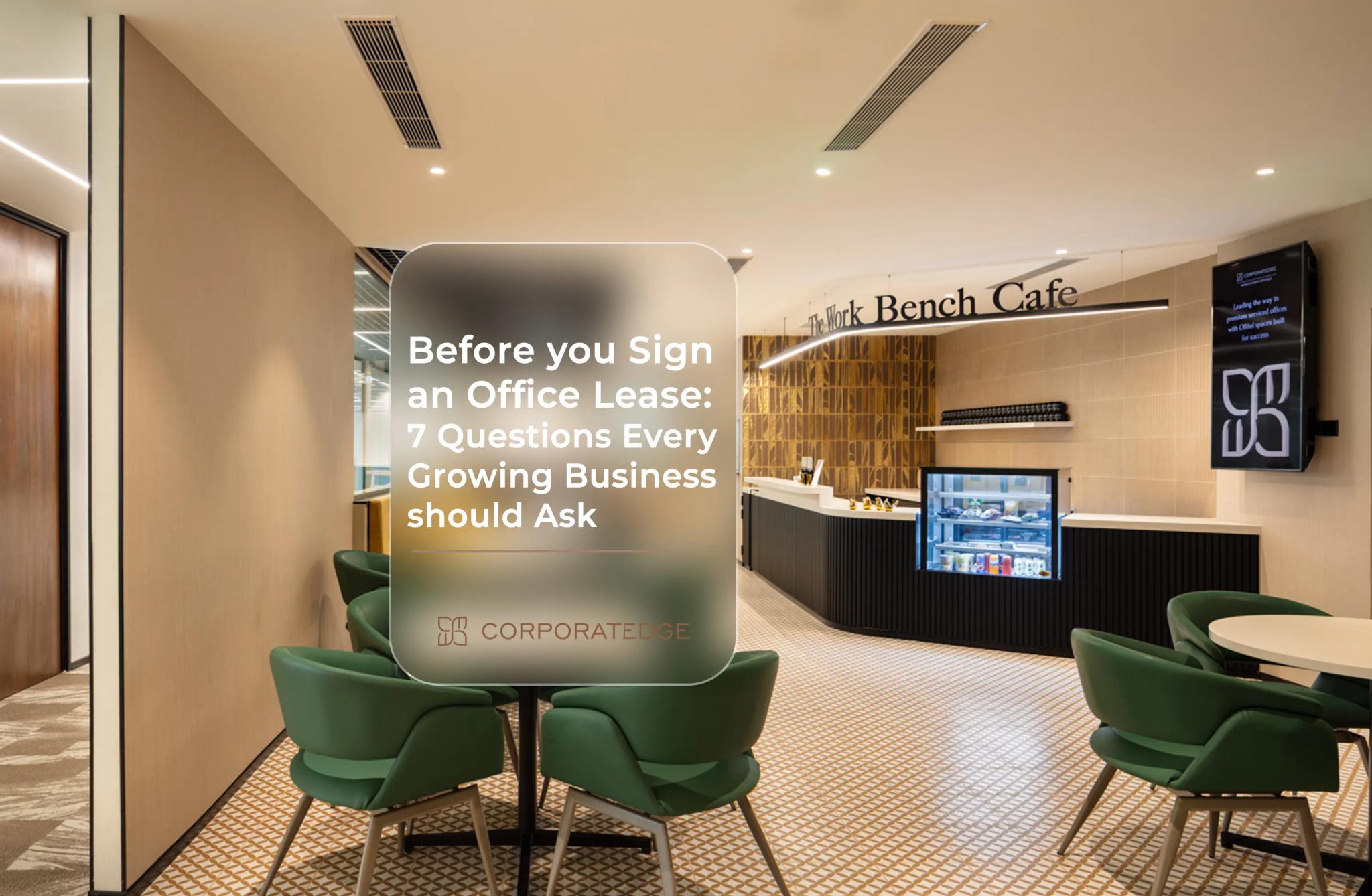
Before You Sign an Office Lease: 7 Questions Every Growing Business Should Ask
There is a moment in every growing business when the office starts telling a story.
The team has grown. The meeting rooms are always occupied. New people are joining faster than expected. What once felt spacious now feels like it was designed for a smaller version of the business.
Naturally, the next thought is: We need a bigger office.
But choosing an office is not simply about finding more desks or a better-looking address. It is a business decision that can shape how your people work, how your clients experience your brand and how easily you can adapt as the company grows.
A space can look perfect during a 30-minute site visit and still create problems six months later.
The rent may be only one part of the actual cost. Meeting rooms may be difficult to access. Parking may become a daily frustration. Your team may outgrow the space sooner than expected. And suddenly, the office you chose to support growth becomes something you have to work around.
So before you sign an office lease, ask a more useful question than Does this office look good?
Ask: Will this office continue to work for our business?
Here are seven questions worth answering before you make the commitment.
1. How Much Office Space Do We Actually Need?
The answer is rarely as simple as counting employees.
If you have 20 employees but only 12 regularly work from the office, you may not need 20 permanent desks. But if you expect to hire another 10 people over the next year, taking a space that barely accommodates today's team could leave you looking for another office sooner than planned.
Start with your current headcount. Then look 12 to 18 months ahead.
Think beyond workstations, too.
Will you need cabins for leadership? Meeting Rooms for clients? Quiet spaces for calls? A reception area? Storage? A pantry? Space for informal conversations? Perhaps an Events space for town halls or team gatherings?
The right office space should accommodate the way your business works today without making tomorrow unnecessarily difficult.
It is also worth asking what happens when you need more space.
Can you add workstations? Can you move into a larger Private Workspace in the same building? Can your office expand without forcing the entire team to relocate?
That flexibility can be just as valuable as the square footage itself.
2. What Will the Office Really Cost Every Month?
This is where the headline rental number can be misleading.
A seemingly attractive office lease can become considerably more expensive once the additional costs start adding up.
Before signing, ask for a complete picture of your monthly and one-time expenses, including:
• Rent and common area charges
• Electricity and air conditioning
• Internet
• Parking
• Maintenance
• Cleaning
• Security
• Furniture
• Reception services
• Pantry services
• Meeting room usage
• Fit-outs and interiors
Then compare the total cost of occupying the office, not simply the rent.
This is also where a serviced office or managed workspace can change the equation.
With a conventional lease, the responsibility for setting up and running the office often sits with you. Furniture needs to be procured. Internet needs to be arranged. Vendors need to be managed. Maintenance needs to be coordinated.
A serviced office brings many of these requirements together under one operating model.
The question, therefore, is not simply, Which office has the lower rent?
What will it actually cost us to run this workplace?
3. Will Your Employees and Clients Find the Location Easy to Reach?
An impressive office address means little if getting there becomes a daily challenge.
Look at where your employees live. Understand how they commute. Check public transport, metro connectivity, major roads, parking and cab availability.
Then consider your clients.
Can they reach the office easily? Is it close to the business districts where you typically meet? Are there hotels, restaurants and other amenities nearby?
For businesses looking for office space in Gurgaon, locations such as Golf Course Road and the wider commercial districts around it can be attractive because they bring workplaces, hospitality, retail and connectivity into the same ecosystem.
But don't evaluate a location from a map alone.
Visit it at 9 AM.
Visit again around 6 PM.
Look at the traffic. Check the parking. Take the lift. Walk around the building. Notice what the experience feels like when the building is actually operating at full capacity.
Because your employees and clients will experience the location at those times too.
4. What Happens When Your Business Changes?
This is one of the most important questions to ask before signing an office lease.
Because businesses rarely stay exactly the same for the duration of a lease.
Your team may grow faster than expected. You may move to a hybrid model. You may need fewer desks. A new business unit may require additional space. You may even decide to consolidate teams.
Understand your options before those changes happen.
Pay close attention to:
• Lock-in period
• Security deposit
• Notice period
• Rent escalation
• Renewal terms
• Early exit conditions
• Additional desks
• Expansion options
• Downsizing options
• Relocation within the building or network
Most importantly, make sure these terms are documented in the agreement.
If your headcount is difficult to predict, flexible office space can provide an alternative to committing to a large conventional lease upfront.
The right workplace should not only accommodate growth. It should allow you to respond to change.
What Should You Look For When You Visit an Office?
Don't judge a workplace from the reception and boardroom alone.
Walk through the actual working areas.
Sit at a desk.
Listen to the noise levels. Check the natural light. Look at the washrooms. Visit the pantry. Test your mobile network. See how crowded the lifts get. Notice how people move through the space.
These details rarely appear on a floor plan.
But they become part of your team's everyday experience.
And over time, those everyday details can matter more than the first impression.
5. Are There Enough Meeting Rooms and Private Spaces?
Picture a typical Tuesday morning.
A client meeting starts at 11. HR has an interview scheduled at the same time. Two senior leaders need to take separate confidential calls. Someone else has a video conference with a team in another city.
Where does everyone go?
A workplace can have plenty of desks and still feel inadequate if there aren't enough places for conversations that need privacy.
Before choosing an office, understand:
• How many Meeting Rooms are available
• How many people each room can accommodate
• Whether rooms need to be booked in advance
• Whether meeting rooms are included or charged separately
• Whether smaller rooms or phone booths are available
• Whether larger spaces are available for presentations or events
Not every conversation needs a boardroom.
Sometimes a quiet room for two people is more valuable than another large conference room.
The workplace should support the different ways your team actually communicates.
6. Does the Office Fit the Way Your Team Works?
There is no universally perfect office.
A law firm may need enclosed cabins and privacy. A sales organisation may benefit from teams sitting together. A hybrid company may need fewer permanent desks but more collaborative spaces.
Your workplace should reflect your operating model, not someone else's.
Private Workspaces can work well for teams that want a dedicated environment without taking on the entire burden of setting up and managing a conventional office.
Co-Working can suit smaller or evolving teams that need professional workspace without committing to a large footprint.
Virtual Offices can be relevant for businesses where employees primarily work remotely but the company still needs a professional business address and access to physical space when required.
Meeting Rooms can provide a professional setting for client conversations, interviews and internal meetings without requiring a large permanent office.
And when your business needs to bring people together beyond the everyday workspace, access to an Events space can make everything from workshops to company gatherings easier to organise.
The point is not to choose a particular format.
It is to choose a workplace that matches the way your business actually works.
7. Who Takes Care of the Office After You Move In?
This is the question many businesses ask too late.
The office is ready. The team has moved in. And then the Wi-Fi stops working.
Who do you call?
The air conditioning isn't working. Who handles it?
A client arrives while your team is in a meeting. Who receives them?
A chair breaks. The pantry needs attention. A meeting room needs to be reset. The office needs cleaning.
Who owns all of this?
In a conventional leased office, many of these responsibilities sit with the company.
With a serviced or managed workspace, several of them may be handled by the workspace provider.
The exact scope varies, so ask the question upfront.
Because an office isn't simply four walls, desks and a name on the door.
It is an operating environment.
Key responsibilities to clarify:
• Internet and IT-related issues
• Cleaning
• Air conditioning
• Security
• Visitor management
• Repairs and maintenance
• Furniture
• Pantry services
• Meeting Rooms
• Reception
So, What Kind of Office Should a Growing Business Choose?
There is no single answer.
A conventional office lease can make sense when your headcount, footprint and long-term requirements are relatively predictable.
A Private Workspace can give a growing team a dedicated environment without requiring it to build an office from scratch.
Co-Working can provide flexibility for smaller or evolving teams.
Virtual Offices can work for businesses that operate remotely but still need a professional business address and access to physical workspace when required.
And Meeting Rooms and Events spaces can provide additional flexibility without requiring businesses to permanently pay for space they only use occasionally.
At CorporatEdge, the thinking starts with the business rather than the box.
Private Workspaces, Co-Working, Meeting Rooms, Virtual Offices and Events are designed around different ways businesses operate and grow.
Because the right workplace isn't necessarily the biggest one.
It is the one that works for your people, your clients, your business model and the direction you're heading.
Before you sign the lease, look beyond the office. Look at the business you are building inside it.
Frequently Asked Questions
What should I check before signing an office lease?
Look beyond the quoted rent. Review the total cost, location, space requirements, parking, Meeting Rooms, amenities, lease terms, lock-in period, exit conditions and the flexibility to expand or reduce your space.
How do I decide how much office space I need?
Start with your current headcount and expected hiring over the next 12 to 18 months. Then account for workstations, cabins, Meeting Rooms, reception, storage, pantry and collaborative areas based on how your team works.
Is Co-Working suitable for a growing business?
Co-Working can be useful for businesses with changing team sizes or companies that want professional workspace without committing to a large conventional office lease.
What additional costs can come with an office lease?
Depending on the property and agreement, businesses may incur additional costs for electricity, air conditioning, internet, maintenance, cleaning, parking, furniture, fit-outs and Meeting Rooms.
Should I visit an office before signing the lease?
Yes. Visit during actual working hours, ideally more than once. Look at traffic, parking, connectivity, noise, natural light, lifts, Meeting Rooms and the overall working environment before making a decision.
More from the Journal
 Journal
5 Oct 2026 · 13 min read
Private Office vs Coworking Space in Gurgaon: Which Workspace Is Right for Your Business?
Compare private offices vs coworking spaces in Gurgaon to choose the right workspace for your business based on cost, privacy, flexibility, and growth.
Explore More Journal
29 Jun 2026 · 6 min read
How to Relocate an Office Without Disrupting Business Operations
Learn how to relocate an office smoothly with practical tips on planning, communication, IT setup, vendor coordination, and business continuity.
Explore More Journal
25 Jun 2026 · 6 min read
The Anchor of the Hybrid Era: Elevating the Modern Office Experience
For years, the corporate world operated on a simple rule: productivity required a fixed desk, a daily commute, and a five-day office week. The hybrid era is rewriting that.
Explore More
A workspace as consideredas your work.
Explore how CorporatEdge designs, delivers and manages workspaces for India's leading enterprises and GCCs.